
CSEA Webinar: Generative AI in Structural Engineering Design
Written by Chaoyi Wang, reviewed by Duo Huang
On April 12, 2026, the Canada Structural Engineers Association (CSEA) hosted a webinar
presented by Professor Xinzheng Lu from Tsinghua University. The session introduced recent
developments in generative AI and discussed its applications in structural engineering design.
The webinar was held on Microsoft Teams and attracted over 80 participants.

The event was moderated by Yin Li. It began with a brief introduction of the speaker, followed by a short technical overview. The featured presentation covered the topic of “Knowledge-Mechanics” Integrated Generative-AI Design Method for Civil Infrastructures.

The presentation first outlined key challenges in current structural design practice. Traditional workflows rely on manual iteration and depend heavily on engineering experience. Coordination across disciplines is frequently necessary, but the process is time-consuming and constrains efficiency gains.

Generative AI was introduced as a new approach to support structural design. By using high-
quality engineering datasets, AI models can generate structural layouts directly from
architectural inputs, reducing the need for repeated manual adjustments. Integration with CAD tools and cloud platforms allows faster iteration and helps complete early-stage design more efficiently.

Several applications were demonstrated, including structural layout generation, beam
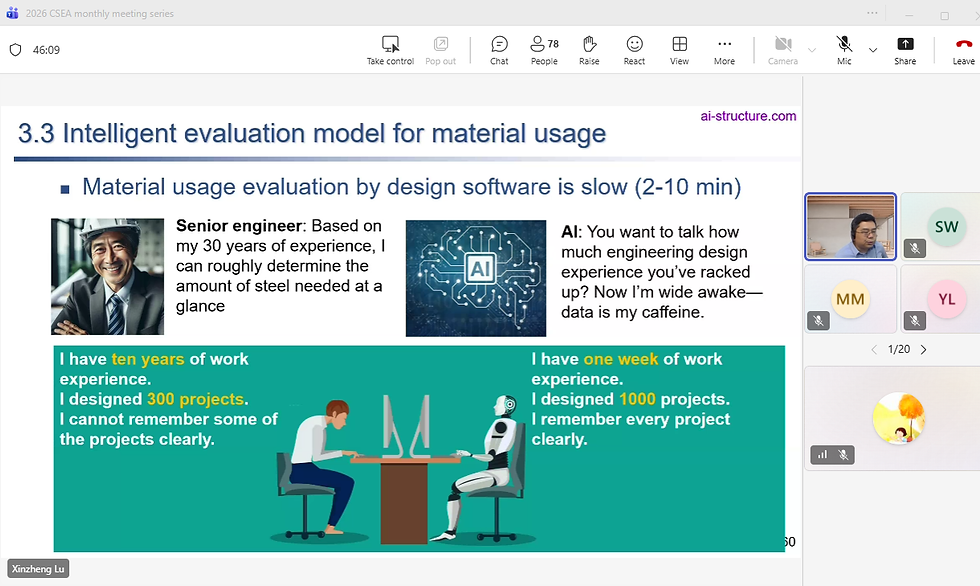
arrangement, and shear wall design. Material usage evaluation was also presented. Case
studies showed that AI-generated results can be comparable to engineer-developed designs when combined with optimization.

The presentation also introduced applications in multiple engineering fields, such as building design, bridge engineering, dam structures, fire safety systems, and solar photovoltaic (PV) systems. These examples show strong potential for use in different types of projects.

Following the presentation, a Q&A session was held. Participants raised questions on topics
such as whether AI could replace engineers and whether it can replicate engineering judgment.
The discussion provided further clarification on the current capabilities and limitations of AI in engineering practice.

The event concluded with a closing speech by Yin Li, who summarized the discussion and
thanked the speaker and participants for their engagement.

The session showed that generative AI can reproduce conventional engineering design. As a
result, the future value of engineers will increasingly depend on innovative solutions beyond
standard optimization.

Overall, the webinar provided a clear overview of how generative AI is being integrated into
structural engineering workflows. It also showed that these tools can reduce repeated design
work and help complete early-stage design more efficiently.


Comments